Ball Valve:
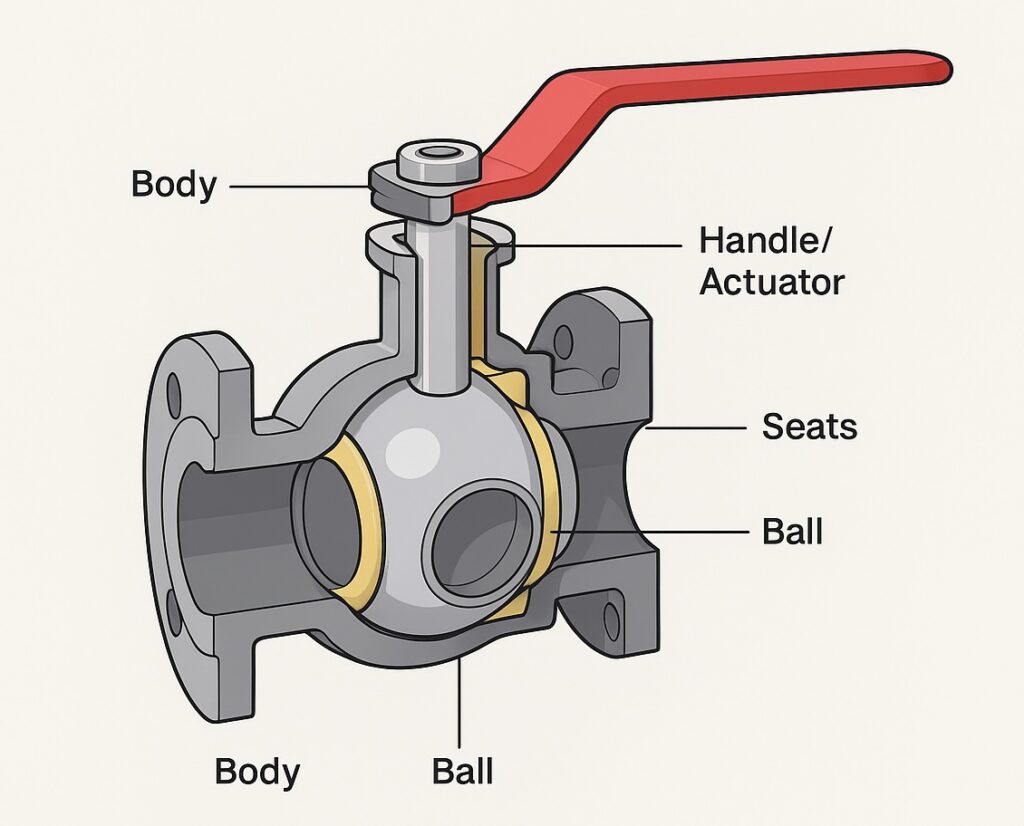
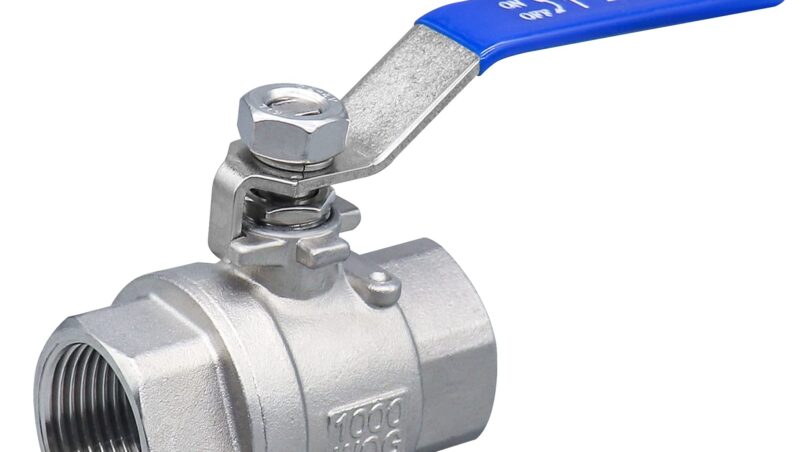
A ball valve is a type of quarter-turn valve that uses a hollow, perforated, and pivoting ball to control the flow of liquids and gases. It is one of the most widely used valves in industrial and domestic applications due to its durability, tight sealing, and quick operation. Ball valves are known for their ability to provide reliable shutoff even after long periods of disuse.
What is a Ball Valve?
It consists of a spherical ball with a hole (called a bore) through its center. When the hole aligns with the flow direction, the valve is open, and when it is rotated 90 degrees by the handle or actuator, the valve closes. This simple operation makes ball valves highly efficient for on/off control of flow.
Construction of Ball Valve
The main components include:
- Body – The outer casing that holds all components together, usually made of steel, brass, or PVC.
- Ball – A spherical component with a hole (bore) that controls flow.
- Seats – Soft or metallic rings that provide sealing between the ball and the body.
- Stem – Connects the ball to the handle or actuator, allowing rotation.
- Handle/Actuator – Used to rotate the ball manually (lever handle) or automatically (electric, pneumatic, or hydraulic actuators).
- Seals and Packing – Prevent leakage around the stem and body.
Working Principle of Ball Valve
It works on a quarter-turn principle:
- When the handle is turned parallel to the pipeline, the bore of the ball aligns with the pipe, allowing full flow.
- When the handle is turned perpendicular to the pipeline, the bore is blocked, and flow stops.
- Intermediate positions can also regulate flow, although ball valves are primarily designed for on/off control rather than throttling.
Types of Ball Valves
- Full Port Ball Valve – The bore size is equal to the pipe diameter, offering minimal pressure drop.
- Reduced Port Ball Valve – The bore size is smaller than the pipe, causing a slight pressure drop.
- Floating Ball Valve – The ball is held in place by two seats and floats slightly to press against the downstream seat, ensuring tight sealing.
- Trunnion Mounted Ball Valve – The ball is fixed and supported by trunnions, suitable for high-pressure and large-diameter applications.
- Multi-Port Valve – Allows flow in multiple directions, often used in mixing or diverting applications.
Applications of Ball Valve
Ball valves are versatile and used in a wide range of industries, such as:
- Oil and Gas Industry – For controlling crude oil, natural gas, and refined products.
- Water and Wastewater Treatment – Ensuring tight shutoff in pipelines.
- Chemical and Petrochemical Plants – Handling corrosive fluids and high-pressure applications.
- Pharmaceutical and Food Industry – For hygienic processing lines.
- HVAC Systems – Controlling heating, ventilation, and air-conditioning pipelines.
- Domestic Plumbing – Used in household water supply systems.
Advantages
- Provides tight sealing with minimal leakage.
- Simple and quick operation (quarter-turn).
- Long service life with minimal maintenance.
- Suitable for high-pressure and high-temperature applications.
- Compact design and cost-effective.
Limitations
- Not ideal for throttling or precise flow control.
- Soft seat materials can be damaged by high-temperature fluids.
- Larger sizes can be heavy and expensive.
- Frequent operation in partially open positions may cause wear.
Conclusion
A ball valve is a highly reliable and efficient flow control device that finds application in industries ranging from oil and gas to domestic plumbing. Its ability to provide a bubble-tight shutoff, combined with simple operation and durability, makes it one of the most trusted valve types in the world. While it has some limitations, it remains a cornerstone in modern fluid handling systems.