Rotameter -Introduction

A rotameter is a simple and widely used device for measuring the flow rate of liquids and gases in a closed tube. It belongs to the category of variable area flow meters, where the cross-sectional area available for fluid flow increases as the flow rate increases. Due to its accuracy, reliability, and ease of use, the rotameter has become one of the most popular instruments for flow measurement in various industries.
What is a Rotameter?
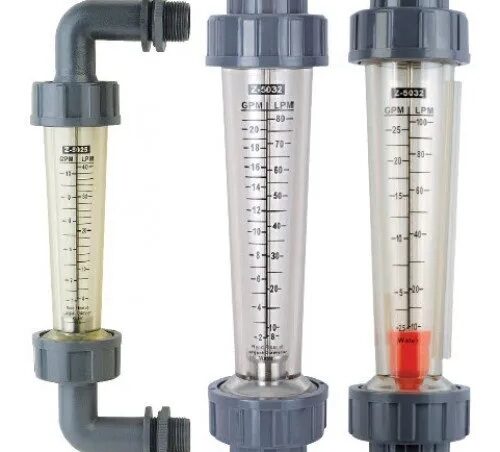
A rotameter consists of a vertically oriented, tapered glass or plastic tube with a float inside. The float moves up and down depending on the flow rate of the fluid. The position of the float provides a direct indication of the flow rate, usually read against a calibrated scale marked on the tube.
Construction of Rotameter
The main components include:
- Tapered Tube – Usually made of glass, plastic, or metal, wider at the top and narrow at the bottom.
- Float – A specially shaped object (made of metal, glass, or plastic) that moves up and down within the tube.
- Scale – A calibrated scale is marked on the tube to indicate flow rate directly.
- End Fittings – Connectors that allow the meter to be installed into a pipeline.
Working Principle of Rotameter
The rotameter works on the principle of variable area flow measurement.
- When fluid enters the bottom of the tube, it pushes the float upwards.
- The float rises until the upward force (fluid velocity) balances the downward force (weight of the float and gravity).
- At equilibrium, the float remains steady at a position corresponding to a certain flow rate.
- The position of the float is read against the scale to determine the flow.
Types of Rotameters
- Glass Tube Rotameter – Used for clean liquids and gases at low pressure.
- Metal Tube Rotameter – Suitable for high pressure, high temperature, and opaque fluids.
- Plastic Tube Rotameter – Lightweight and economical, often used in water treatment and laboratories.
- Electronic Rotameter – Equipped with sensors and transmitters for digital monitoring.
Applications of Rotameter
Rotameters are widely used across industries due to their versatility. Some key applications include:
- Water and wastewater treatment plants – Monitoring water flow.
- Chemical and process industries – Measuring corrosive liquids and gases.
- Pharmaceutical and food industries – Ensuring accurate flow control in production lines.
- Laboratories – For calibration and experimental setups.
- HVAC systems – Monitoring air and gas flow.
Advantages
- Simple and easy to use.
- No external power supply required.
- Provides direct visual indication of flow rate.
- Can be used for both liquids and gases.
- Cost-effective and low maintenance.
Limitations
- Requires vertical installation.
- Not suitable for very high viscosity fluids.
- Accuracy can be affected by pulsating flows.
- Glass tube types are fragile and may break under high pressure.
Conclusion
A rotameter is a reliable, economical, and straightforward flow measuring device. Its design makes it ideal for applications where visual monitoring of flow is sufficient, and its variants allow use in industries ranging from chemical processing to water treatment. Despite some limitations, rotameters remain one of the most preferred choices for flow measurement worldwide.